IN A NUTSHELL
With ambitious new waste and recycling legislation rolling out over the next few years - like consistency in collections and food waste recycling nationwide - local authorities need a clear strategy for citizen engagement and behaviour change. Without it, we risk increasing confusion, reducing motivation and lowering participation in recycling. Working with the team at WRAP, we designed a tailored behaviour change recycling strategy for Kent County Council to improve recycling behaviours, support the delivery of Simpler Recycling and EPR, and enable them to address challenging settings such as flats and communal properties, with a clear roadmap for delivery across the next 5-years.
Insight
The Kent Resource Partnership (KRP) is a strategic partnership of 12 Waste Collection Authorities (WCAs) and Kent County Council (KCC). Together, the partnership is responsible for delivering consistent, high-quality waste and recycling services across a diverse mix of urban, rural, coastal and commuter communities. Currently, Kent achieves a recycling and compositing rate of 41%, with significant variation across districts.
Whilst the partnership is committed to improving recycling performance, progress has plateaued in recent years, with high levels of recyclable material being lost to residual waste and contamination undermining material quality. New services planned for Simple Recycling reforms - such as food waste collections - introduce additional complexity for residents.
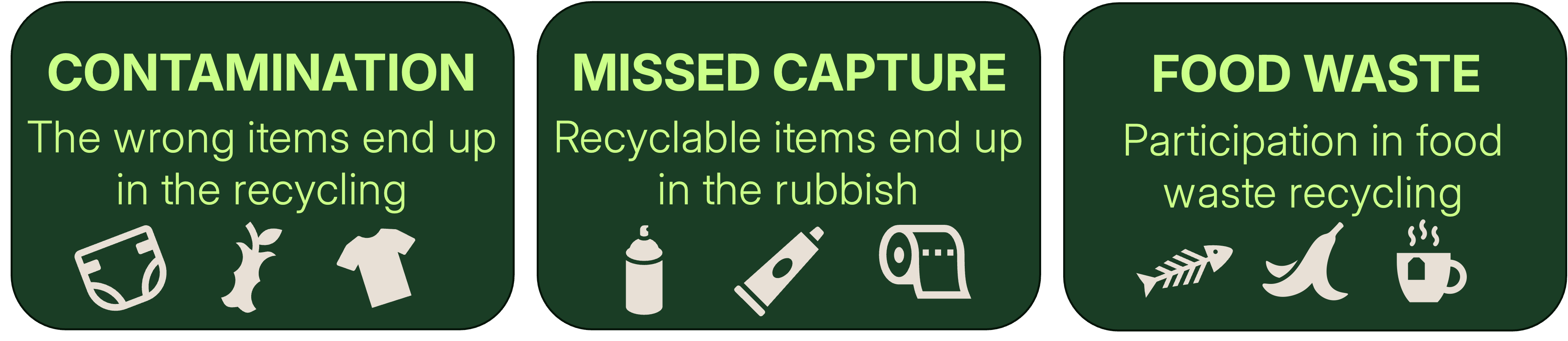
The partnership recognised that service changes alone would not deliver sustained improvement. Instead, a deeper understanding of resident behaviour, confidence and capability was needed to ensure existing and new services work effectively for everyone.
Waste composition analysis data showed that:
- Over a third of household residual waste could have been recycled at kerbside, the largest element being food waste, followed by dry recyclables.
- Contamination rates in dry mixed recycling were persistently high, with a small number of commonly misunderstood items responsible for a large share of errors.
Qualitative and quantitative research to understand resident behaviours and challenges found:
- Feelings of worthwhileness and trust in recycling is low: people questioned whether their recycling efforts have a real impact, particularly when they lacked visibility of outcomes.
- Knowledge gaps persist: Confusion about specific materials remained high, often leading to guessing and mistakes.
- Service experience matters: Residents interpreted cues such as bin condition, crew behaviour, and communications as indicators of how much councils valued their recycling efforts.
- Food waste routines were fragile and inconsistent: Issues such as smells, leaks, pests and caddy hygiene created friction, particularly for households new to the service, and caused lapsed use of the service.
"I’ve heard stories that the local authorities just take the bins and dump them all in one pit"
Strategy
To reset momentum and ensure new services are embedded successfully, we worked with KRP to design an insight-led strategy and behavioural framework, aligned to service delivery (accounting for key changes in Simpler Recycling over the next 5 years) but focused on addressing the underlying drivers of recycling behaviour.
The strategy is built around a three-stage framework designed to tackle the behavioural and structural barriers for recycling in Kent:
- Behavioural interventions: Use five key behavioural tools with proven effectiveness in driving recycling behaviour to test interventions that are adapted for local contexts.
- Targeted communication: Deliver clear, regular and locally relevant messages that show tangible benefits for recycling in Kent.
- Service consistency and quality: Ensure residents experience accessible, reliable, and clearly explained waste and recycling services.
The approach combines behavioural insight, proven tools and local flexibility to support consistent improvement across diverse districts, and allows for continuous improvement throughout the five-year period.
Kent County Council are currently delivering the strategy across Kent and we are looking to support delivery with individual councils throughout the strategy period.
Impact
"I don't think we would have such clear next steps that our partners are bought into without WRAP and Behaviour Change's expertise. Having them facilitate workshops with all partners as a new, impartial voice, with a wealth of experience and examples was invaluable.
This work has helped us focus on priorities and make a strong case for investing in trial projects and communications campaigns. We will consider future collaboration with them to deliver this framework effectively."
We have already seen an impact on Kent's recycling efforts with a 22% increase in food waste recycling over the festive period compared the previous year.