IN A NUTSHELL
Mars Wrigley has long been a leader in tackling litter from its products, investing in campaigns and partnerships across the UK for many years. Having worked with Behaviour Change since 2015 on gum litter, Mars Wrigley asked us to expand our scope to confectionery litter more broadly – recognising that confectionery wrappers present a distinct behavioural challenge, and one with growing political and reputational stakes as EPR regulations began to take shape. Our ‘Gnomes’ intervention led to a reduction in litter count by 19% and increased positive public perceptions of their local park and council.
Insight
We started by reviewing the existing evidence base, which told us that confectionery packaging is the second most common litter type after cigarette butts – yet almost no research had examined it as a distinct behaviour. To fill that gap, we commissioned fresh qualitative research with confectionery litterers.
What emerged was a clear behavioural picture. Confectionery is eaten frequently, habitually, and without much thought, often as part of a routine or when someone needs a quick lift. Littering happens in a moment of cognitive load: there's an immediate urge to dispose of the wrapper, little thought about what happens to it next, and confectionery litter is viewed as a minor, almost passive transgression. Litterers often describe packaging as being "taken away by the wind", positioning themselves as bystanders rather than agents.
We mapped these findings against the COM-B behavioural model to identify where we had genuine room to intervene – specifically around making people feel observed, increasing the sense of personal ownership over packaging, and reducing the perceived acceptability of dropping litter in a given environment.
Intervention
We ran a pilot in Croydon working with the local authority. In a workshop, we shortlisted interventions that applied behavioural pressure through observation and social norms, while remaining positive, humorous and genuinely enjoyable for people using the spaces.
In Croydon's Wandle Park, we developed the Gnomes intervention – life-sized gnomes, dressed in high-vis vests to acknowledge the workers looking after green spaces, peeking out from behind trees to keep a watchful eye on park users.
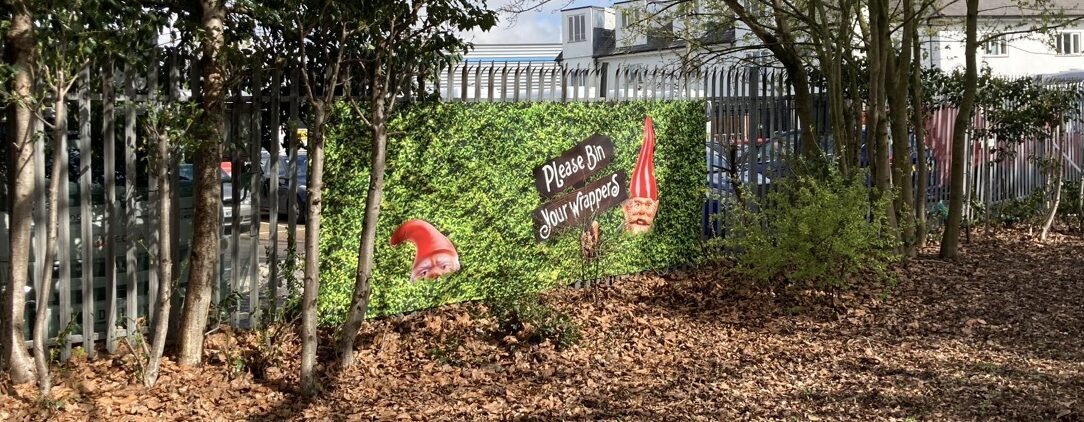
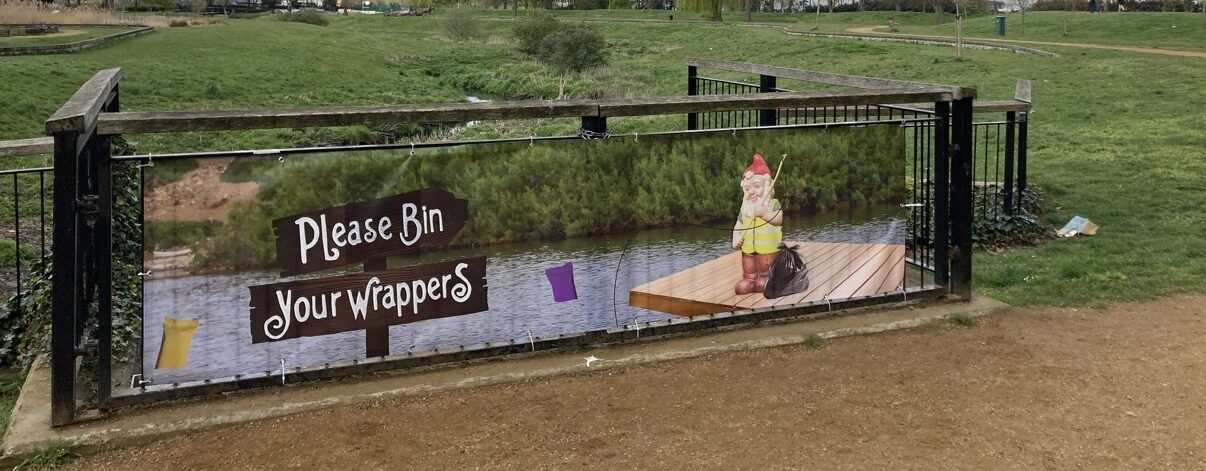
The intervention drew directly on the behavioural insight that people are less likely to litter when they feel observed, but framed this through warmth and humour rather than finger-wagging or threat-based messaging.
Impact
The intervention produced strong results.
- Levels of confectionery litter count in the park reduced by 19%
- Overall litter count decreased by 23%
- 84% campaign recall from weekly park visitors
Notably, the intervention appeared to improve people's perceptions of the council as well as reducing littering itself.
The results show that locally designed interventions can have a meaningful impact on littering behaviour and that moving away from traditional enforcement-style communications produces more positive community responses.
As a result of the success of the Gnomes concept, the intervention was adapted for the Chewing Gum Task Force, where it now sits as an option for green spaces – evidence that even a project that shifted direction can produce lasting, transferable outputs.