IN A NUTSHELL
Newcastle-under-Lyme has provided a weekly food waste recycling service since 2010, yet only 32% of households participate in the service and food waste still makes up around a third of residual waste. Newcastle-under-Lyme has a diverse population, including a high proportion of deprived households, transient communities and a large student population. The borough spans both rural and urban communities, with higher-density housing and flats presenting particular challenges for engaging residents in recycling.
To re-engage this community, we developed an intervention centred around a simple message that made the food waste recycling service easier to understand and reinforced it as a long-standing, trusted service. This was tested through on-street signage, plus a reciprocity mechanism and postcard delivered in a bold package. The intervention resulted in a 44% increase in food waste tonnage, alongside an increase in participation and caddy orders.
Insight
Newcastle-under-Lyme already delivers a ‘gold standard’ food waste service: free caddies, free liners, weekly collections, lockable caddies, and an ‘any bag’ model (moving away from compostable liners that received complaints from residents for breaking easily). These are all service conditions we know can support participation, so many of the practical barriers had already been addressed.
The pilot area included communities experiencing high levels of deprivation, with lower than average levels of literacy among some residents. Existing recycling communications may therefore not always have felt as accessible or relevant as they could.
Building on a co-design workshop with the council team, we used behavioural tools to develop potential intervention ideas. We identified three core requirements for the intervention:
- Make the service clear and simple by communicating the key information in an easy-to-understand way
- Position the service as easy and reliable by highlighting that there are minimal barriers to participation
- Create a sense of community by reinforcing that food waste recycling is an established part of life in the local area
Intervention
‘Any bag, Any food, Every week’
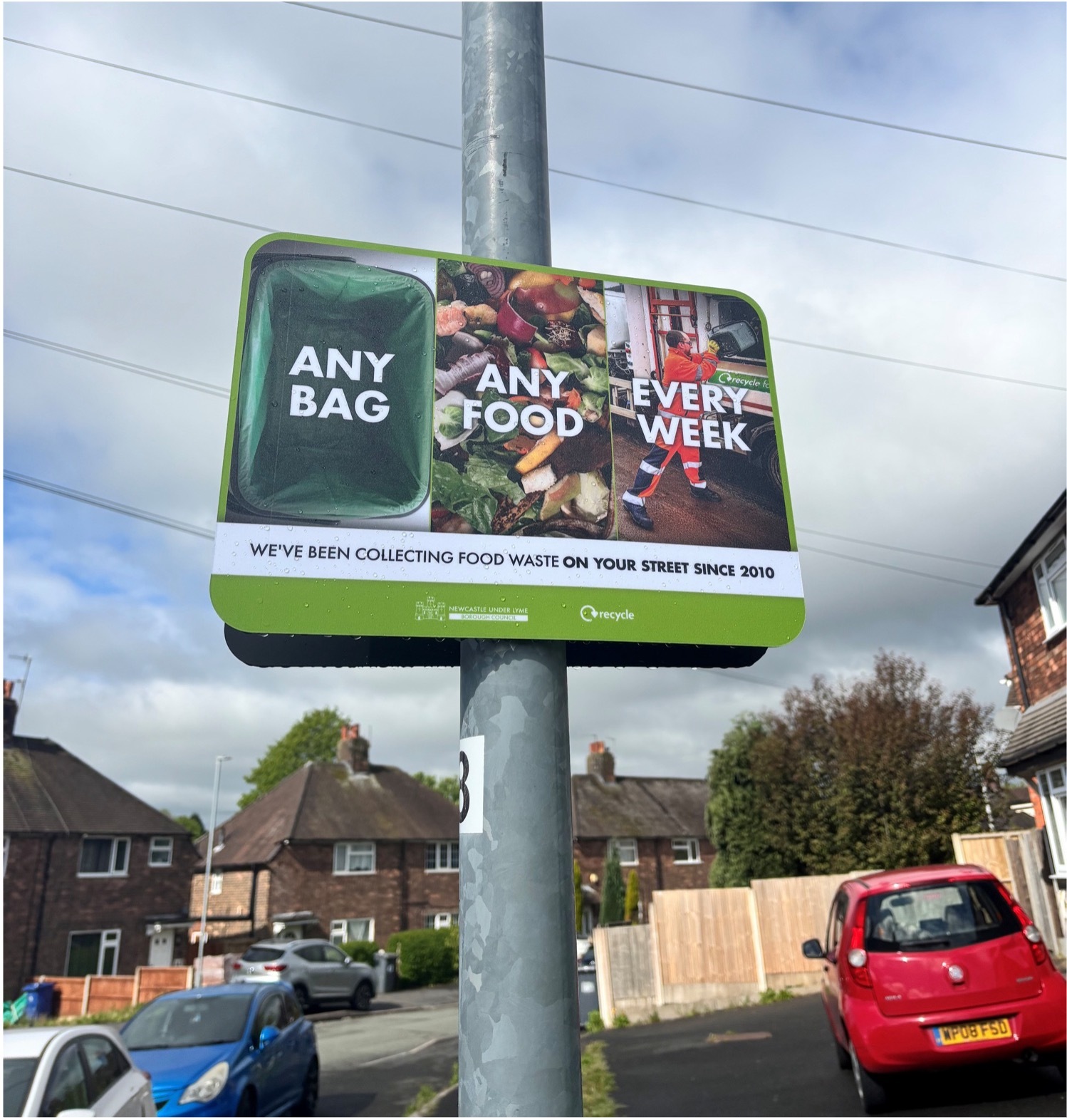
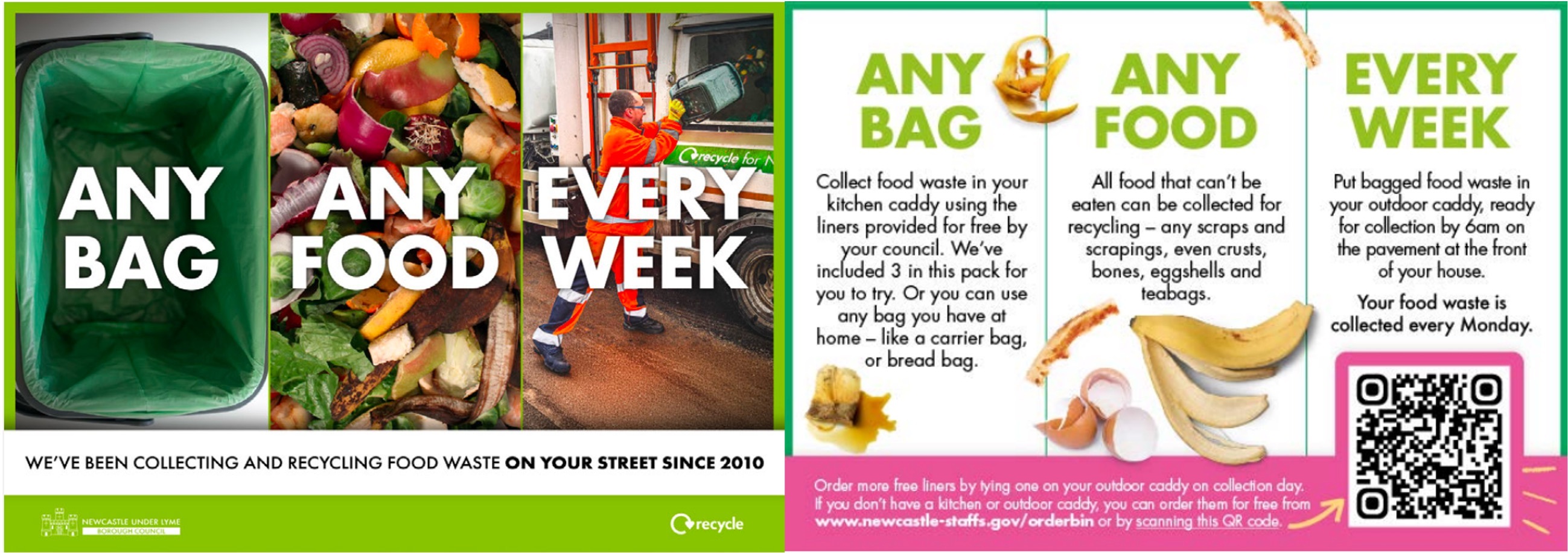
With the objective of trying to articulate the food waste service offer in the simplest way possible, we developed the message ‘Any bag, Any food, Every week’. The message clearly communicates three of the most important things residents need to know to use the service: they can use any bag, any food can be recycled, and their food waste is collected every week.
To build on the longevity of the service and create a sense of local pride, the supporting message was ‘Food waste collections on your street since 2010’. This highlighted that this was a long-standing and reliable service, available to the community.
Implementation
On-street intervention: Lamppost signs
We designed on-street signage aimed to disrupt routines and build visibility of the intervention in the community. Around 400 signs were installed across targeted streets, providing a repeated and highly visible reminder of the service and its key benefits.
In-home intervention: Postcards and free liner package
Post cards using the same creative as the lamppost signs were delivered to households to reinforce the same message. The back expanded on each of the three core elements and included a QR code for ordering a new caddy. These were delivered to approximately 1,100 households that were not presenting a food waste caddy for collection on the day.
The in-home intervention was designed to be as intriguing to open as possible, recognising many households in the area may regularly receive letters and postcards that would often end up in the bin. We did this by:
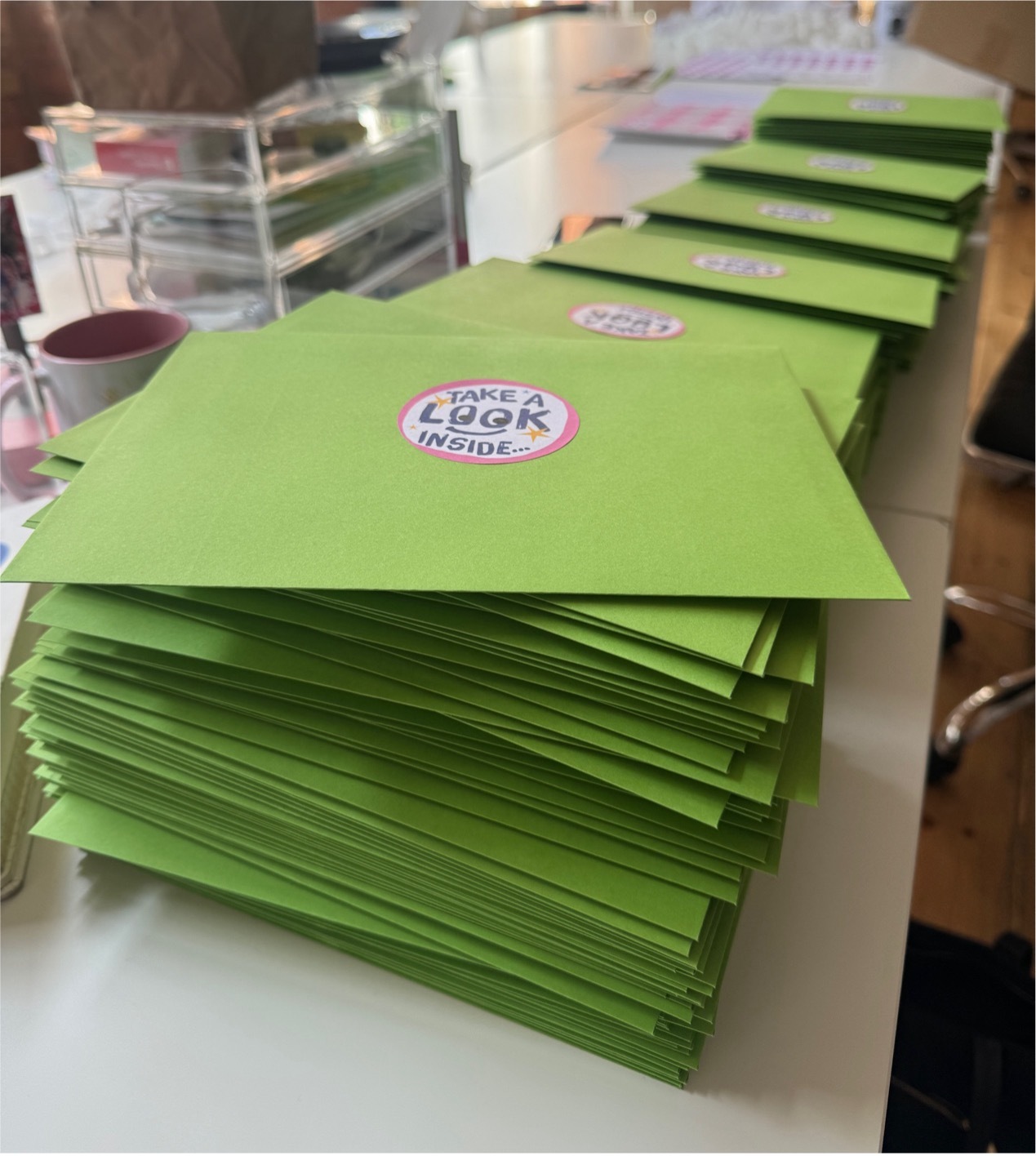
- Delivering the intervention in a bright green envelope featuring colourful ‘open me’ stickers, designed to not look like typical letters or council communications
- Including 3 free liners in the envelope as a reciprocity mechanism. This was a cost-effective way to show the council provides free liners without giving away whole rolls that may not be used; and offers a low-stakes ‘trial period’ to engage with the service. It also made the envelope feel like a package to encourage opening to find out what’s inside.
Impact
The pilot was evaluated using a combination of quantitative and qualitative methods. We monitored participation, measured food waste tonnage, tracked caddy orders and conducted in-depth qualitative interviews.
The intervention led to a 44% increase in food waste collected, showing that there was significant untapped potential even within an already well-designed service. Participation also increased by 2.14%, while caddy orders in the pilot area were disproportionately high: Knutton accounted for 6.6% of all caddy orders across the borough during the intervention, despite representing only around 2.5% of its population.
Qualitative research also suggested that the intervention helped address some of the key areas of confusion around the service, including weekly collections, what food could be recycled and what bags could be used.
Together, the findings suggest that making an existing service simpler, more visible and more salient can help households make better use of what is already available.