Lessons from a very small island — Part 2

David Hall Executive Director
06/11/26
3 mins
Share
My daughter has a lot of hair.
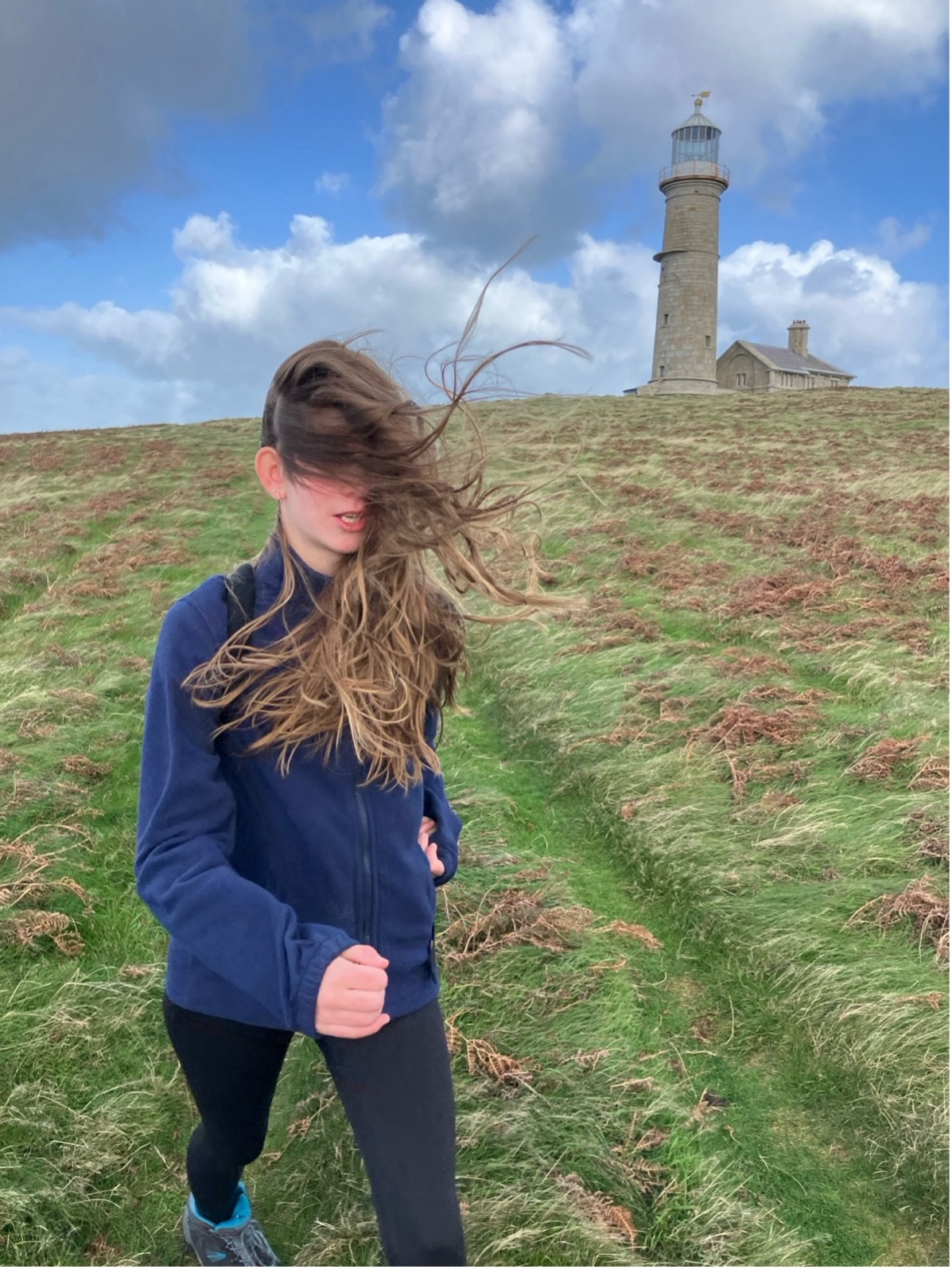
As the photograph demonstrates, she also recently discovered just how quickly it can be restyled by a 60mph gust of wind courtesy of Storm Austen.
But that wasn't her principal hair-based concern during our recent visit to Lundy, the beautiful little island off the Devon coast. Her main objection was to a notice in our accommodation, explaining that the island was experiencing a severe water shortage and asking visitors to limit their showers to two minutes. How, she wanted to know, was she supposed to wash all that hair in two minutes?
Lundy has been experiencing an extraordinary water crisis, with months of dry weather leaving its reservoirs dangerously depleted. Emergency water supplies have been shipped from the mainland, visitors have been asked to make drastic reductions in consumption, and at one point there was even discussion of evacuating the island altogether.
The small team managing Lundy deserves enormous credit for keeping things running in extremely difficult circumstances. But as someone who spends much of his professional life thinking about how to change people's behaviour, I couldn't help noticing a few interesting features of their approach.
What exactly were we being asked to do?
The notice in our accommodation was straightforward.
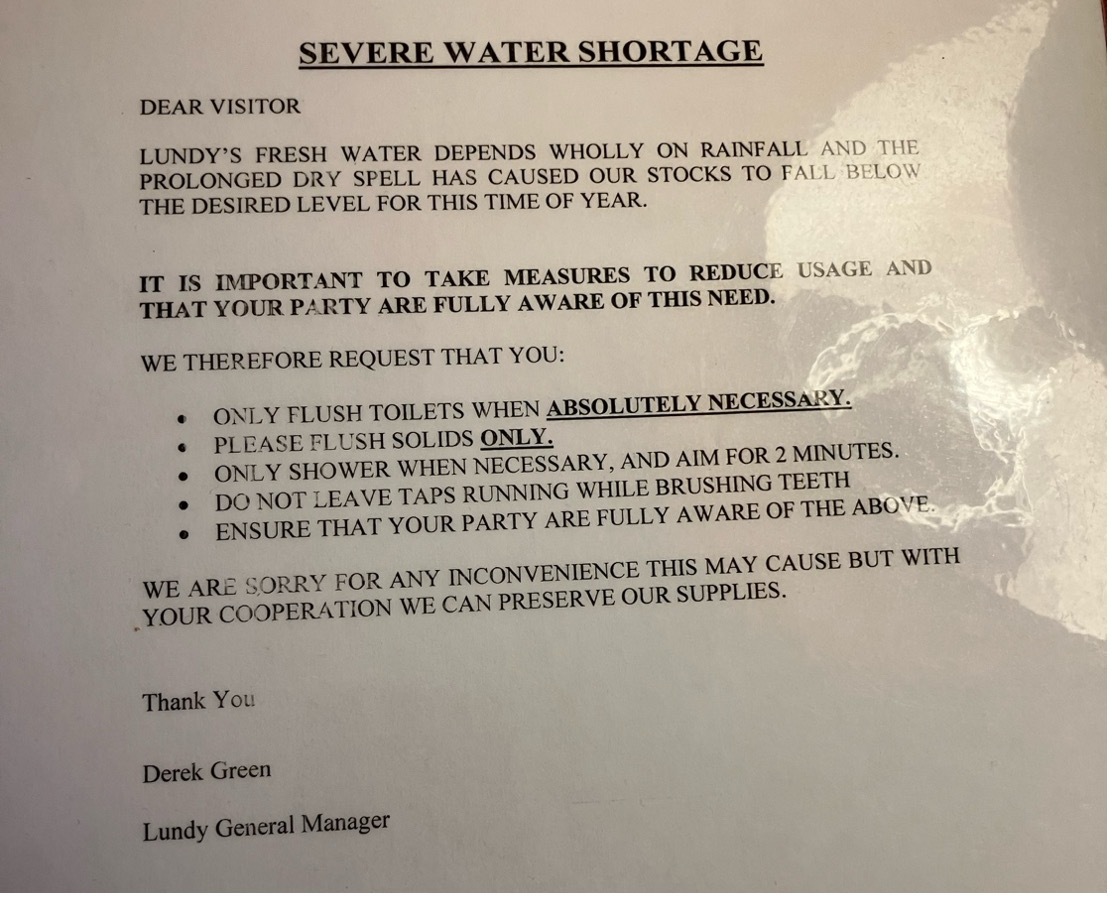
Some of these are pretty good behavioural instructions.
"Flush solids only" is particularly strong even if it gives you the ick.
But the shower instruction is more complicated. For one thing, another notice elsewhere on the island suggested three minutes rather than two. For another, both used the phrase "aim for".
There's nothing necessarily wrong with asking people to aim for an ambitious target. It allows some flexibility after all. But it also leaves considerable room for interpretation. Is four minutes reasonably close to three? What if you're washing your hair? And how many of us actually know how long we spend in the shower anyway?
The risk is that a request which sounds perfectly clear to the person making it becomes rather less clear to the person expected to act on it. And there's a difference between telling people what outcome you'd like and helping them understand how to achieve it. A consistent target, combined with practical suggestions such as turning off the water while shampooing, might make the request easier to follow.
When changing the plumbing doesn't change the behaviour
The island's management had also taken a rather more direct approach to reducing water consumption - they'd removed the plugs from the bath. They'd also taken away the plug from the sink, encouraging people to use a washing-up bowl instead (no dishwashers on Lundy, despite their water-saving benefits if used correctly).
These are interesting examples of changing the physical environment to make certain behaviours more difficult or impossible. Rather than relying on people to make a conscious decision every time, you simply remove the opportunity.
In principle, changing the physical environment can be a very effective way of changing behaviour. But preventing people from doing something isn't necessarily the same as achieving the outcome you want.
A shallow bath might use less water than a long shower, depending on the flow rate and duration (the water pressure, as it happens was astonishingly strong on the island). And while washing-up bowls often save water, what happens when you need to wash something too large to fit into one? You might find yourself repeatedly filling and emptying the bowl, potentially using more water than a single sinkful would have required.
It’s quite possible that neither of these scenarios actually came to pass, but they're useful illustrations of why it's important to consider how people will actually respond to an intervention, rather than simply assuming that a change will produce the desired result.
People work around restrictions. Sometimes the alternatives they find are better and sometimes they're worse. And ultimately, the thing we're trying to reduce isn't the number of baths taken or sinks filled - it's the number of litres consumed.
When having a bath was a privilege
One of the many pleasures of staying in Landmark Trust properties is reading the old visitors' logbooks. And while looking through entries from the 1980s, I noticed something interesting.
Back then, visitors appeared to regard having a bath as something of a privilege, which might or might not be granted by the island's management.
The possibility of not being allowed a bath seems to have been an accepted feature of island life. It also seemed like baths had their drawbacks in those days, with many visitors complaining about the brown and smelly water (it’s still brownish, but no longer smelly).
Fast-forward forty or so years, and my daughter regards being asked to take an infrequent two-minute shower as a challenge to the fundamental principles of civilisation, which is rather a good illustration of how our expectations change.
We tend to think about our consumption of resources in terms of what we need. But what we regard as necessary is also heavily influenced by what we've become accustomed to.
A daily shower, unlimited hot water, electricity available at any hour of the day: these are relatively recent expectations in the long history of humanity. Things that once seemed like luxuries have become conveniences, and conveniences have quickly come to feel like necessities.
Of course, I'm not suggesting that everyone should return to 1980s standards of comfort, let alone early modern ones. But a light bulb moment in our work on food waste came when we realised that “buy what you need” is actually a meaningless instruction, because what people need is not in reality an objectively discoverable amount. What we regard as necessary is shaped by all sorts of factors including things like our desire to be good hosts and providers. Naturally, Shakespeare had already nailed this back in 1605 when he wrote ‘O, reason not the need!’
So it's worth remembering that the amount of water we think we need isn't determined solely by our physical requirements - it's also shaped by habits, expectations and social norms.
A small island, some big behavioural questions
The people running Lundy were dealing with an acute water shortage, in an unusually challenging environment, while simultaneously managing a damaged access road and the aftermath of a major storm. So I’m not for a second suggesting that their efforts were substandard.
Indeed, their main interventions were undoubtedly sensible. Asking people not to flush unnecessarily, for example, is a simple way to reduce demand without requiring much additional equipment or effort.
But the experience also illustrates some important principles about changing behaviour.
We need to understand what people actually do, rather than what we assume they do. We need to make behavioural requests clear, consistent and achievable. And when we change the environment to discourage particular behaviours, we need to think carefully about the alternatives people might adopt – and then measure what really happens.
Lundy provided a fascinating little laboratory for thinking about all this. And while I'm sure its management had rather more pressing things on their minds than setting up randomised controlled trials, it would be fascinating to run some behavioural pilots there.
Happily, Storm Austen did bring the island some desperately needed rain, even if it also prevented us from leaving for a couple of days. As for my daughter, she did manage to wash her hair. Although whether she achieved the two-minute target is probably best left uninvestigated.
Share
RELATED ARTICLES

I took my ring off. Here’s what happened next
When helpful feedback becomes constant, it can start replacing our judgement
01/10/26
Read moreBehavioural science
How hard can it be to get kids to brush their teeth?
Why knowing isn’t doing, and what children’s toothbrushing can teach us about changing behaviour
24/09/26
Read more